IndexCase 02
Reconstruct the emblemo portfolio shell from frozen video evidence
emblemo-portfolio · frozen-evidence · medium · pilot · VIDEO · captured 2026-08-18 · research-only
research-only. The reference captures on this page are derived from third-party media held under a research boundary. They are published so results can be checked, and must not be redistributed or reused as source assets.
Findings
Every recorded attempt. Pin two to four runs to compare captures checkpoint by checkpoint.
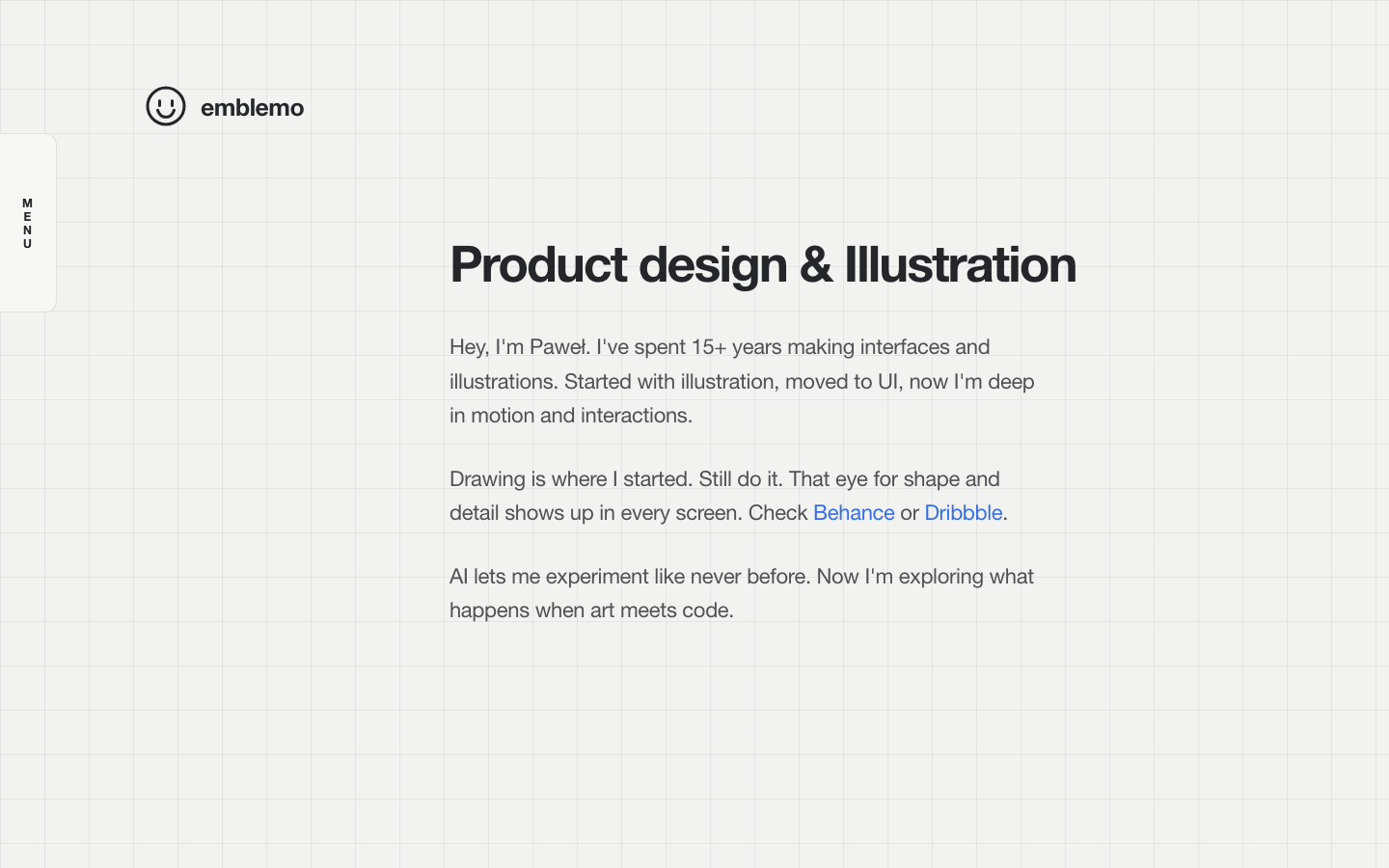
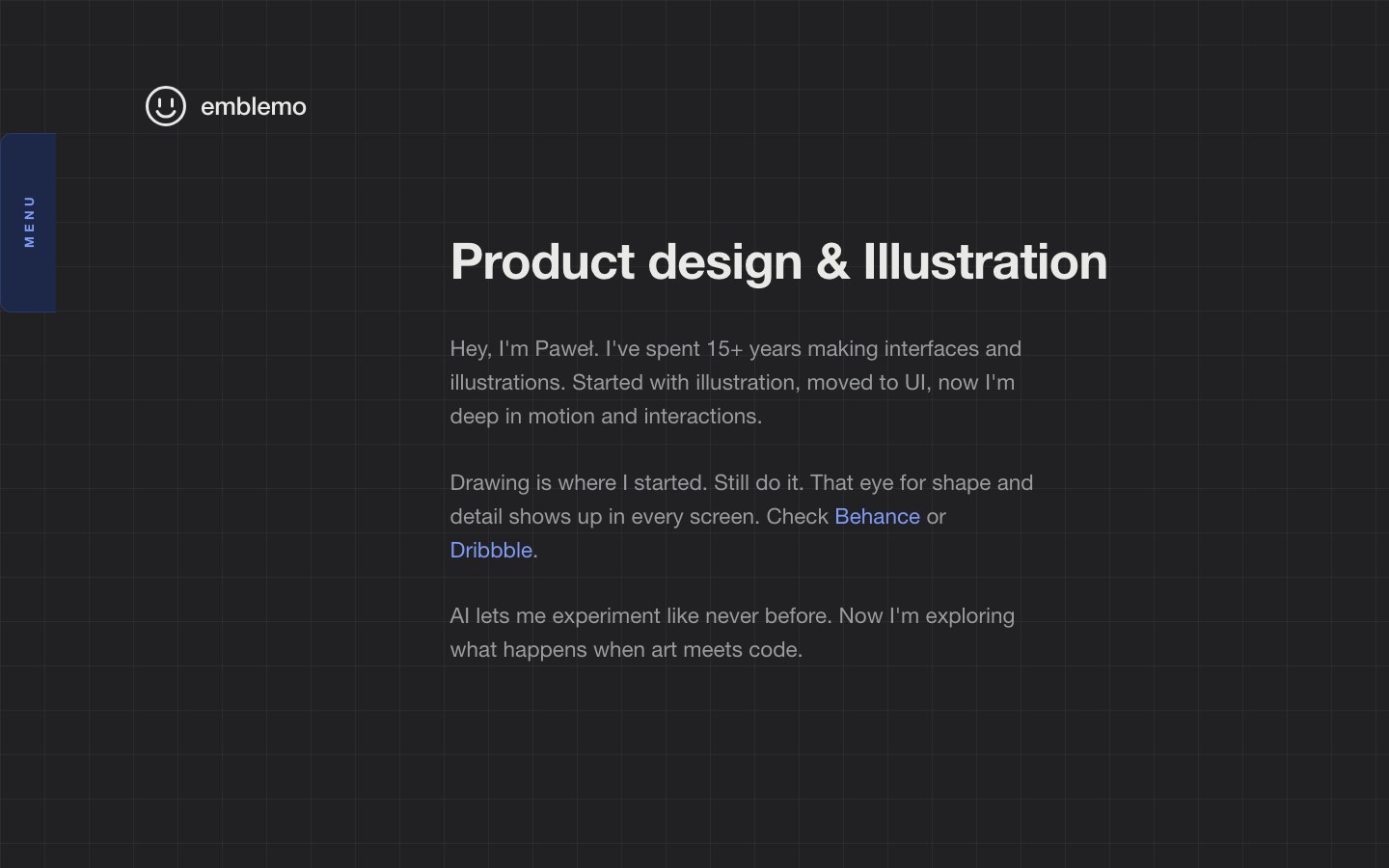
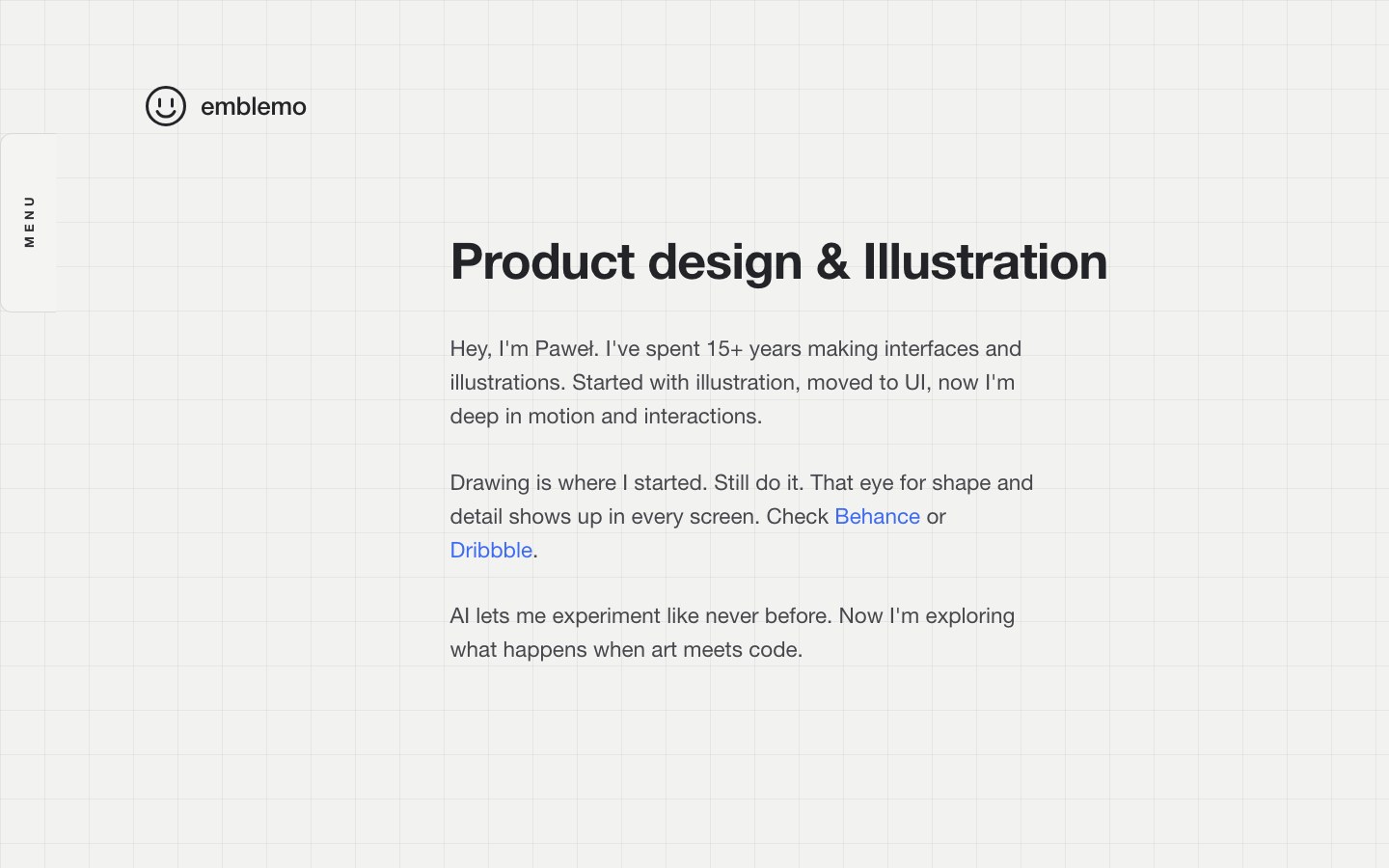
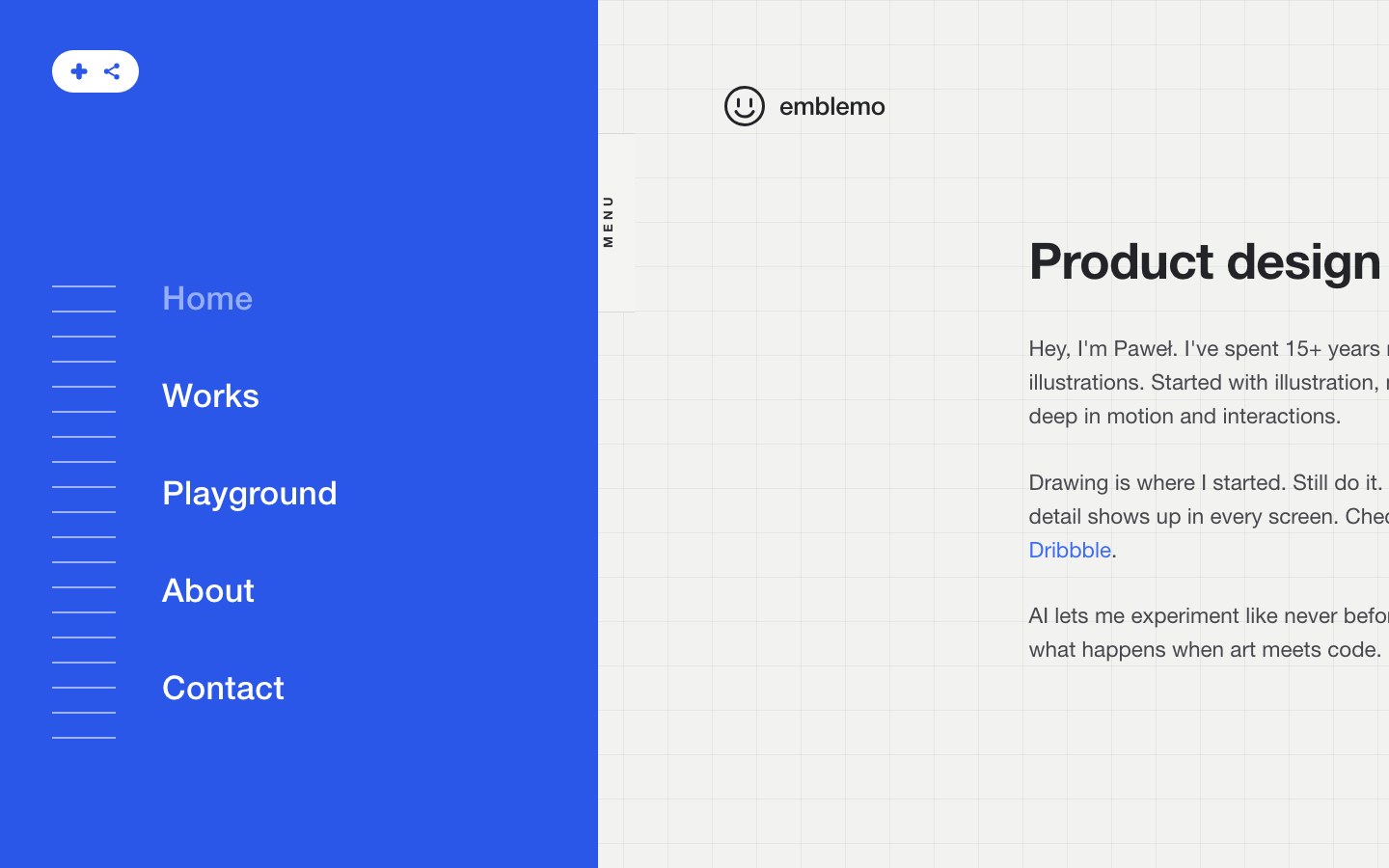
Fig. 01 home · base · 1440×900 · full page
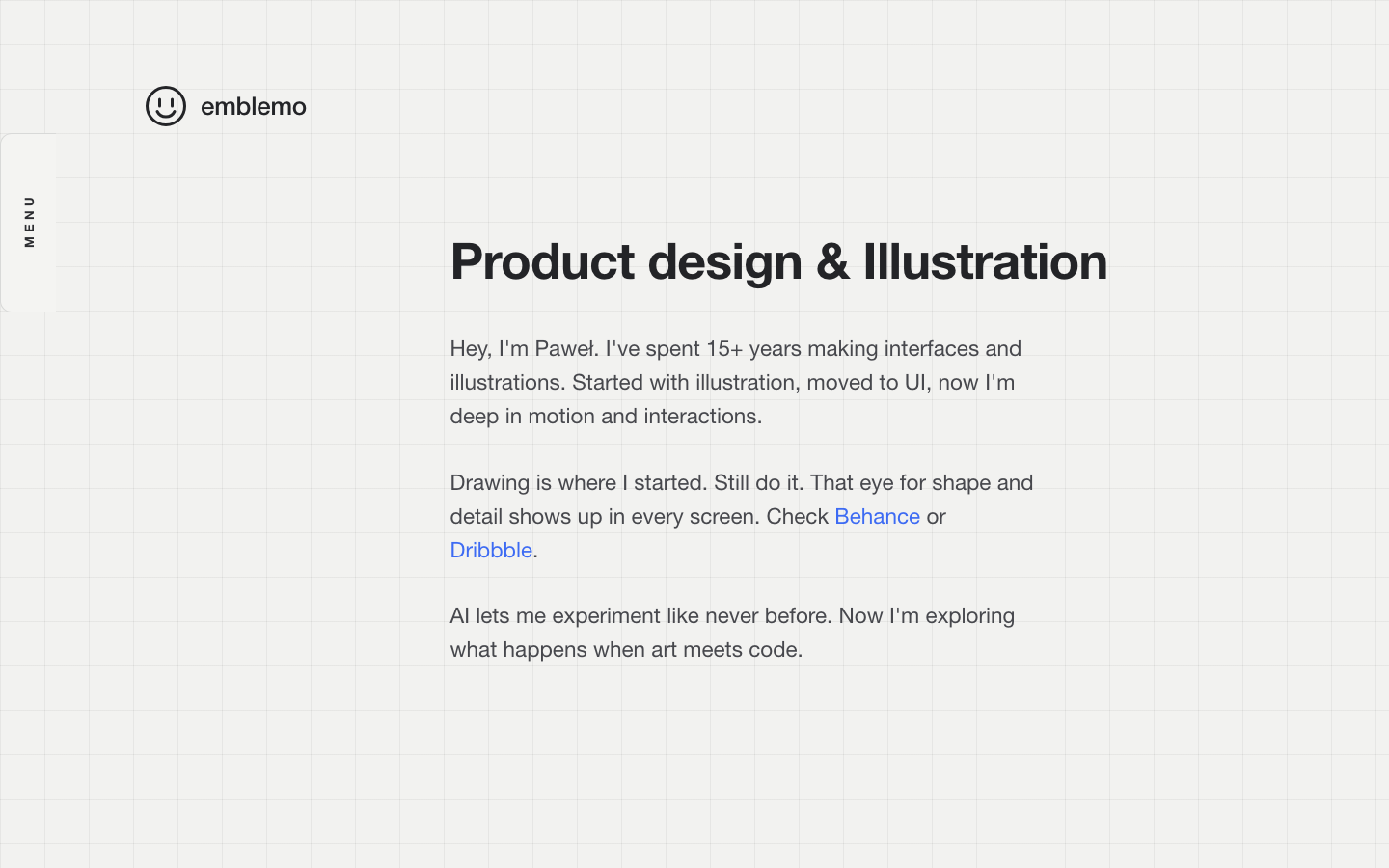
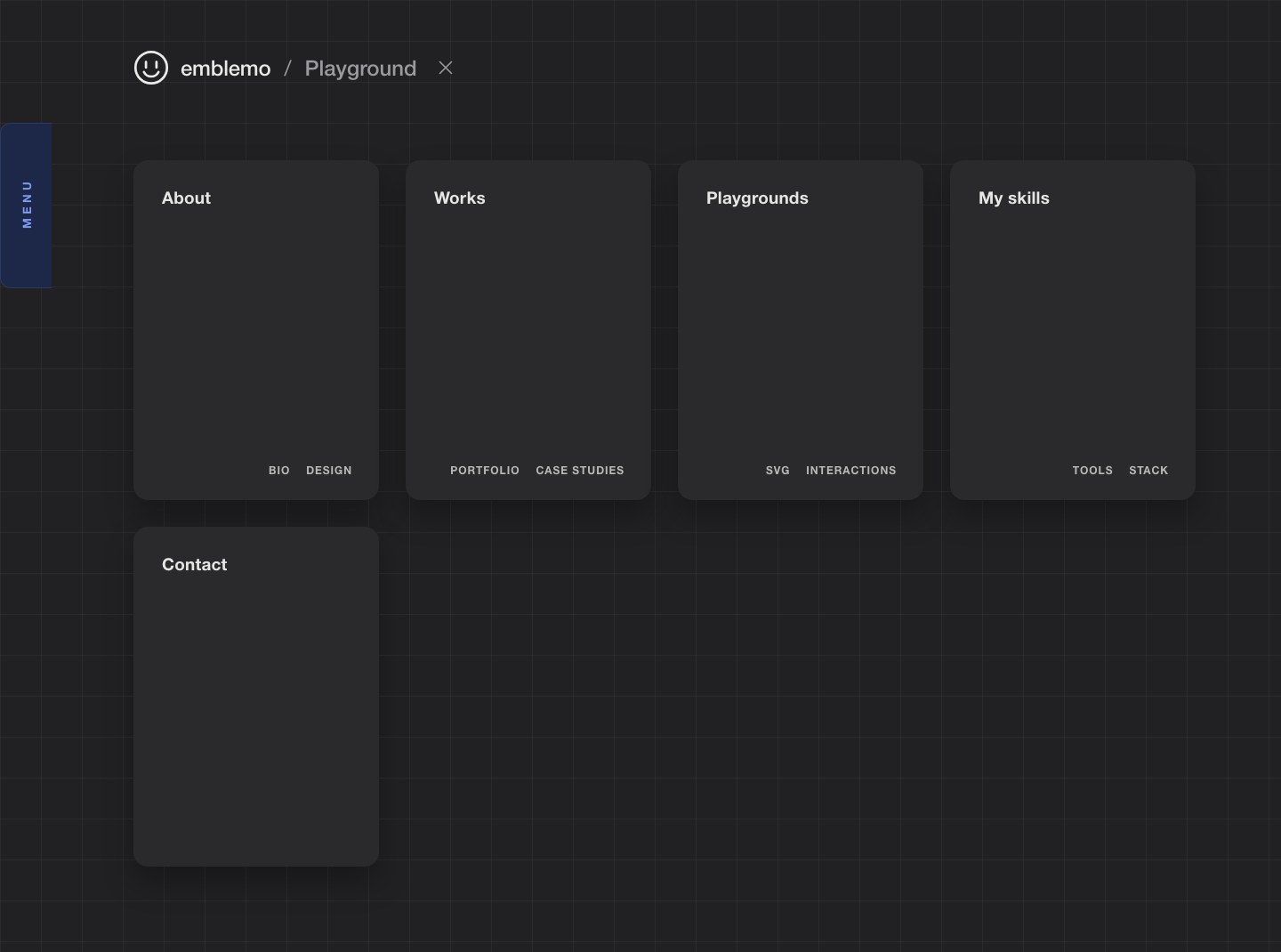
Fig. 02 playground · base · 1440×900 · full page
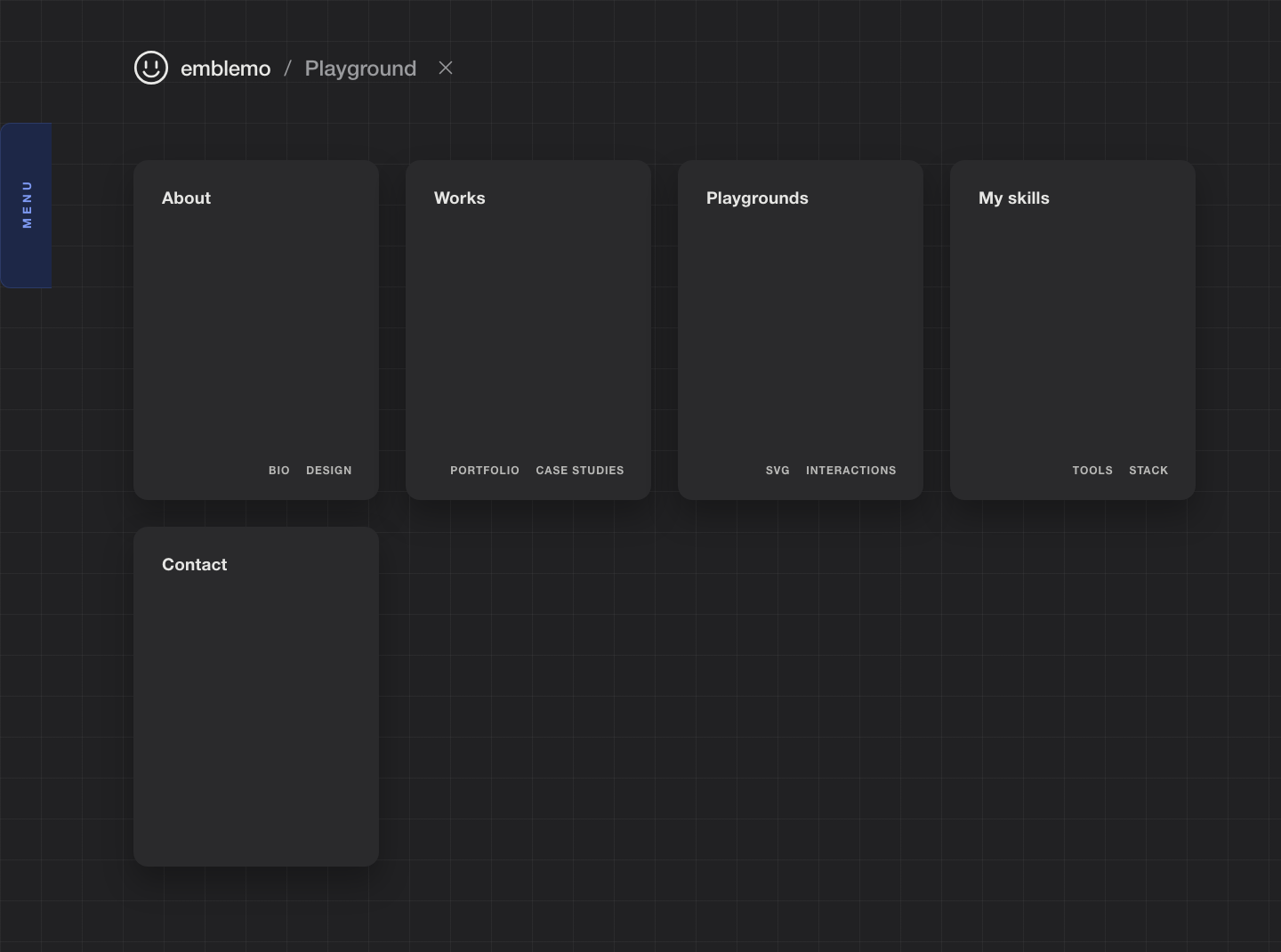
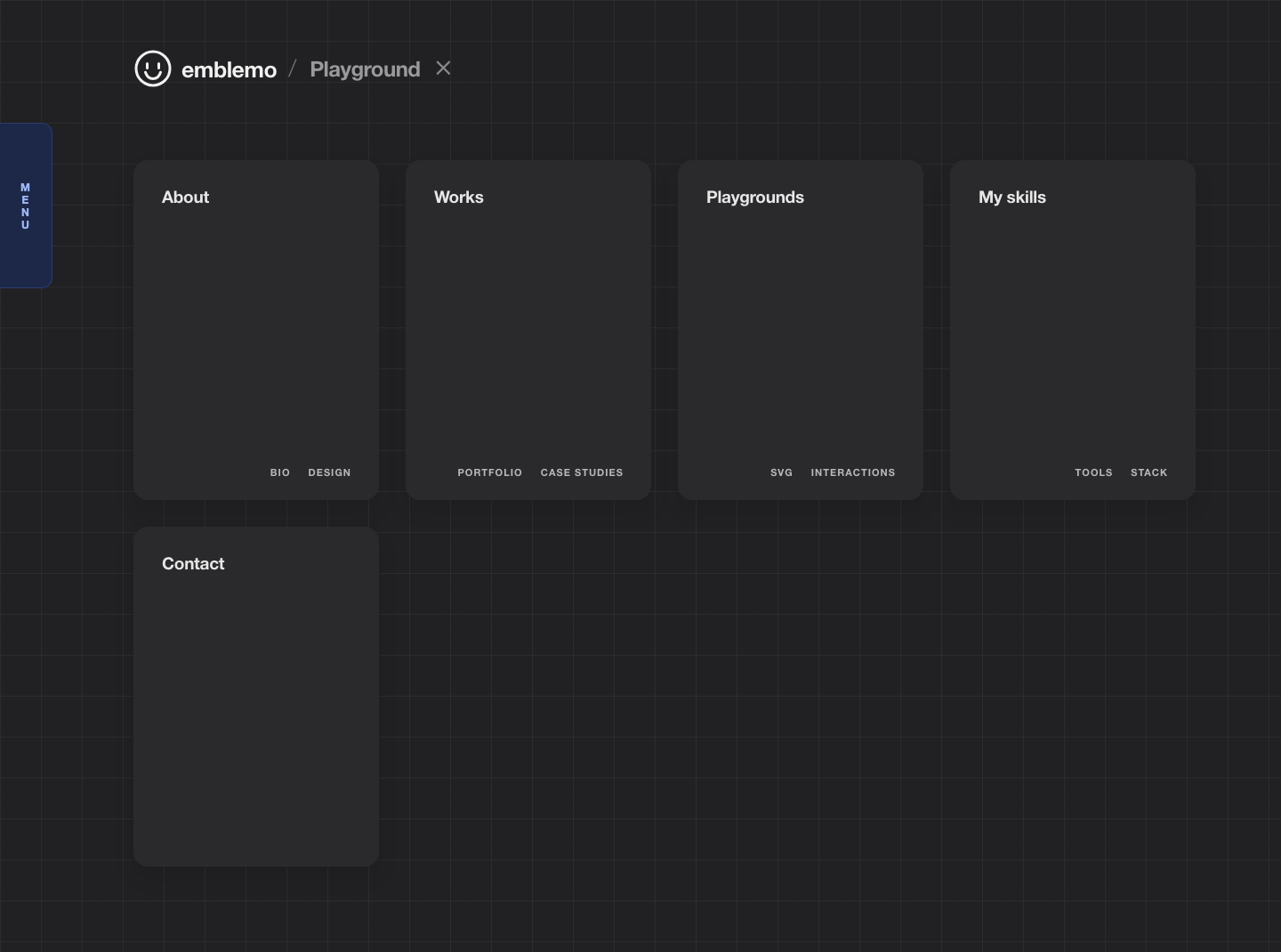
Fig. 03 home-menu-open · state · click
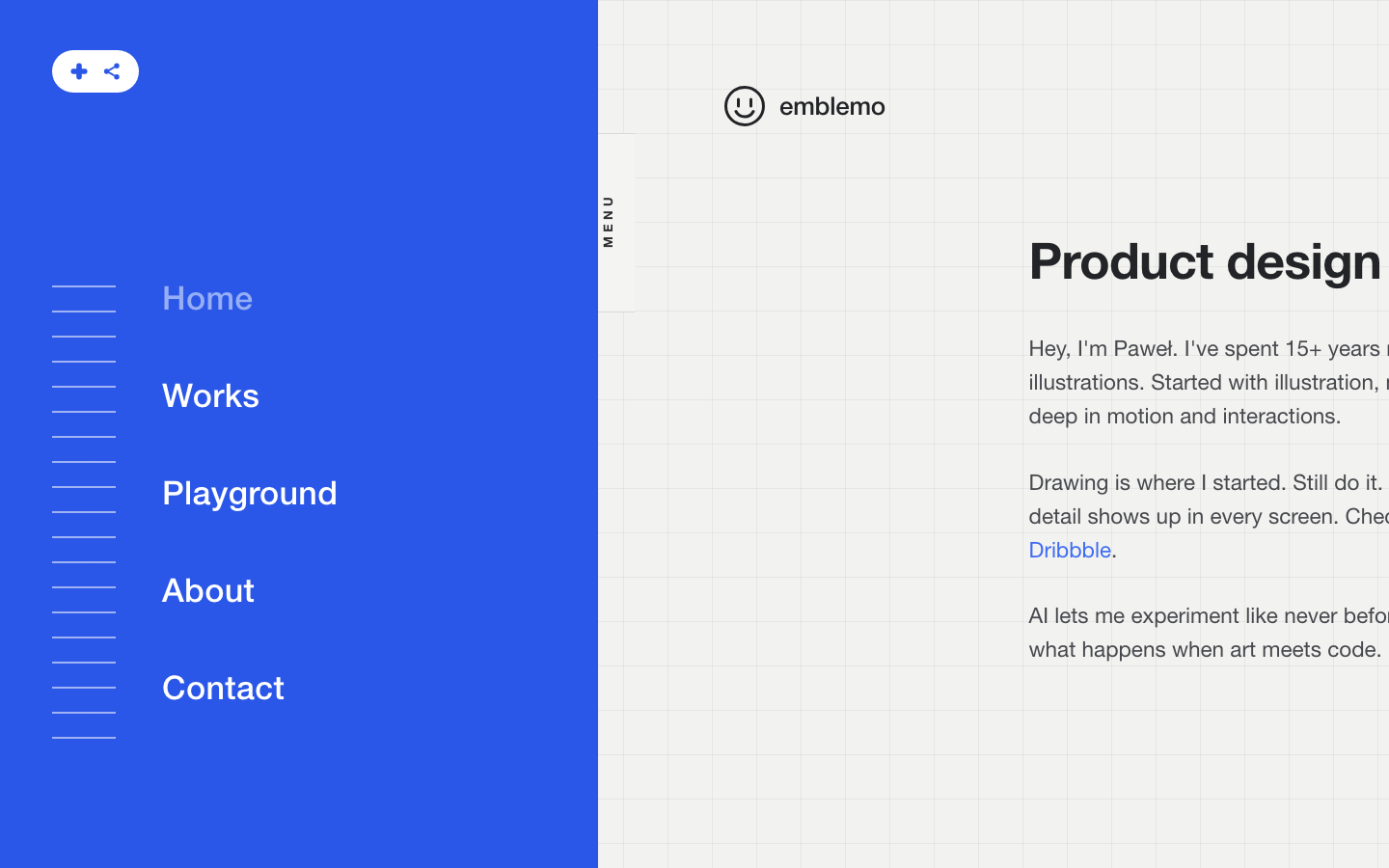
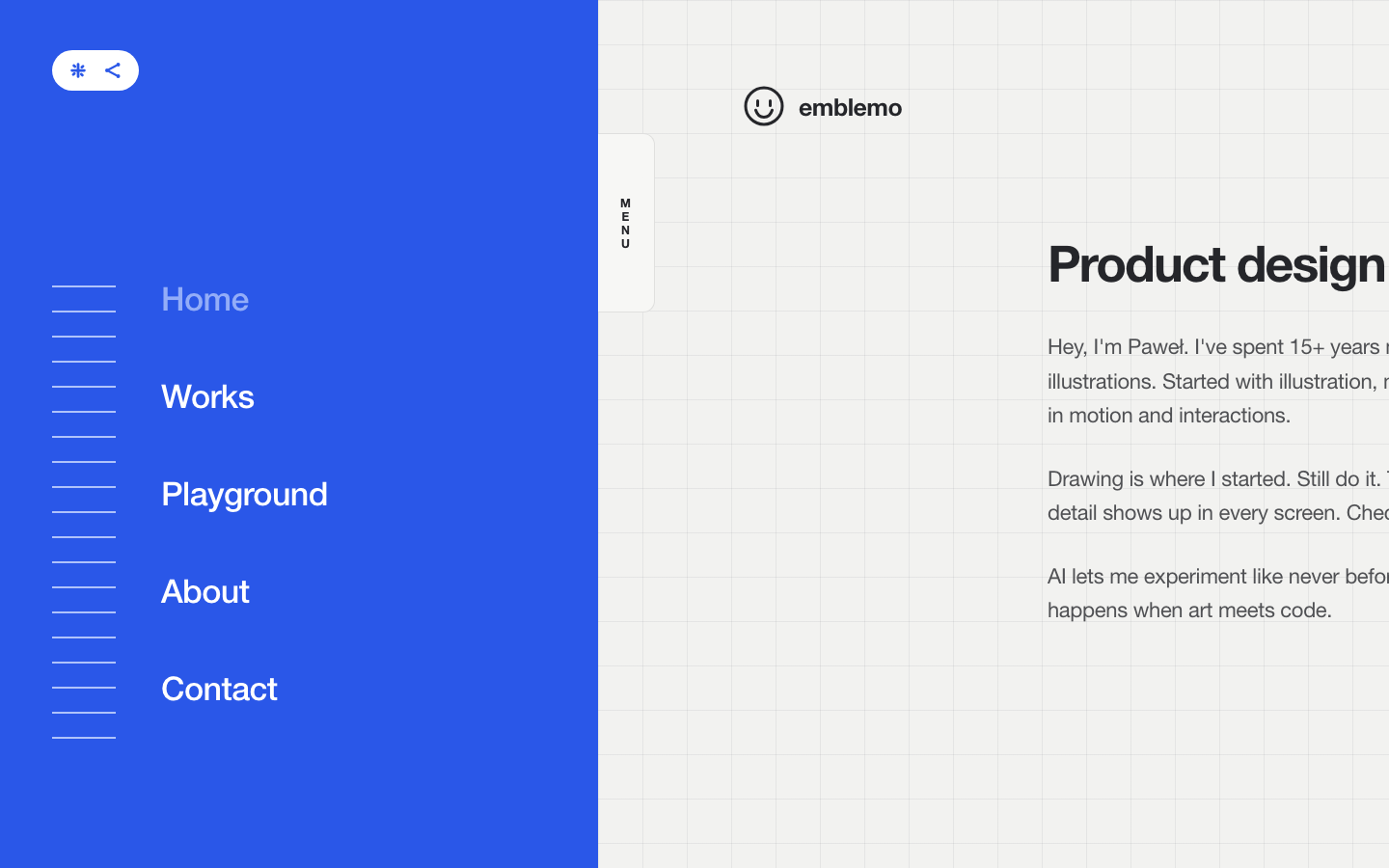
Fig. 04 playground-close · state · click
| Pin to compare | Date | Agent | Variant | Status | Trust | Visual | Func. | Overall | Time | Cost |
|---|---|---|---|---|---|---|---|---|---|---|
| 2026-08-18 | claude_code/sonnet · high | prompt=baseline matrix | running | dev / untrusted | — | — | — | — | — | |
| 2026-08-18 | codex/gpt-5.6-sol · high | prompt=baseline matrix | running | dev / untrusted | — | — | — | — | — | |
| 2026-08-18 | codex/gpt-5.6-sol · high | prompt=baseline pilot | completed | dev / untrusted | 86.6 | 90.9 | 85.7 | 8m 27s | — |
No runs match the current filters.
Provenance
How the case was traced from a discovery link to an authoritative ground truth.
- 01discovery inspora.design
- 02original-post x.com
- 03video-mirror media.inspora.design
- 04live-version-comparison emblemo.space
- 05reference-capture
Frozen evidence (4)
Evaluation matrix
Deterministic. No vision-model judge.
Score composition
Install and build are gates, not weighted components — a failed build scores zero. Raw visual similarity at or below the case floor of 0.16 earns no credit; the remainder is linearly normalized, then weighted 75% visual / 25% functional.
normalized_visual = max(0, (visual - 0.16) / 0.84)
overall = 0.75 * normalized_visual + 0.25 * functional
Visual checkpoints (4)
Deterministic checks (4, total weight 5.0)
| Check | Kind | Target | Weight |
|---|---|---|---|
| home-heading | text | home | 1.0 |
| menu-expands | attribute_after_click | home | 1.5 |
| playground-breadcrumb | text | playground | 1.0 |
| playground-close-returns-home | click_text_change | playground | 1.5 |
Check selectors and thresholds are sealed. Only the identifier, kind, target and weight are published.
Reproduce
Everything a candidate sees is public. The oracle references, grader code and thresholds are not.
skills injected design-case-implementer
1 · Get the workspace
npx degit dairui1/reconbench/cases/emblemo-portfolio/task emblemo-portfolio-task
Pulls only cases/emblemo-portfolio/task/ — the public brief, permitted evidence and the starter codebase.
2 · Copy the prompt
Runtime-agnostic. Paste into any coding agent. Skill files are referenced conditionally so the prompt still makes sense without them.
Use the ReconBench candidate skills `design-case-implementer` in that order. Read those skill files if your workspace provides them, and otherwise follow the same process with your own tools.

You are the candidate in ReconBench task `emblemo-portfolio` (Reconstruct the emblemo portfolio shell from frozen video evidence).

Read `task/brief.md` and every other file under `task/` before changing code.
Implement the result only under `submission/`. The starter may be replaced when the task allows it.
Do not inspect parent directories, benchmark harness files, grader code, reference images, or any oracle material.
Do not call write endpoints belonging to a reference site. Keep forms, counters, and similar behavior local.

Before finishing:
1. Run the requested build command.
2. Start the app and check every target viewport in the task.
3. Exercise the required interactions and inspect browser console errors.
4. Write `submission/submission.json` using the contract in the implementer skill.

The harness will evaluate the filesystem after this process exits. Do not leave a dev server running.
As rendered by the harness for the Codex CLI, including injected skill references.
Use $design-case-implementer.

You are the candidate in ReconBench task `emblemo-portfolio` (Reconstruct the emblemo portfolio shell from frozen video evidence).

Read `task/brief.md` and every other file under `task/` before changing code.
Implement the result only under `submission/`. The starter may be replaced when the task allows it.
Do not inspect parent directories, benchmark harness files, grader code, reference images, or any oracle material.
Do not call write endpoints belonging to a reference site. Keep forms, counters, and similar behavior local.

Before finishing:
1. Run the requested build command.
2. Start the app and check every target viewport in the task.
3. Exercise the required interactions and inspect browser console errors.
4. Write `submission/submission.json` using the contract in the implementer skill.

The harness will evaluate the filesystem after this process exits. Do not leave a dev server running.
As rendered by the harness for Claude Code, including injected skill references.
/design-case-implementer

You are the candidate in ReconBench task `emblemo-portfolio` (Reconstruct the emblemo portfolio shell from frozen video evidence).

Read `task/brief.md` and every other file under `task/` before changing code.
Implement the result only under `submission/`. The starter may be replaced when the task allows it.
Do not inspect parent directories, benchmark harness files, grader code, reference images, or any oracle material.
Do not call write endpoints belonging to a reference site. Keep forms, counters, and similar behavior local.

Before finishing:
1. Run the requested build command.
2. Start the app and check every target viewport in the task.
3. Exercise the required interactions and inspect browser console errors.
4. Write `submission/submission.json` using the contract in the implementer skill.

The harness will evaluate the filesystem after this process exits. Do not leave a dev server running.
3 · Launch
uv run reconbench run \
  --task emblemo-portfolio \
  --agent cc/sonnet \
  --evaluate \
  --allow-untrusted-native

uv run reconbench run \
  --task emblemo-portfolio \
  --agent codex/gpt-5.6-sol \
  --evaluate \
  --allow-untrusted-native
cd emblemo-portfolio-task
codex --model gpt-5.6-sol
# then paste the "Codex" prompt above
cd emblemo-portfolio-task
claude --model sonnet
# then paste the "Claude Code" prompt above
Launch snippets are composed by this site from the case id and the agent selectors present in the bundle. They are a convenience, not a graded contract.
Appendix ATask brief — exactly what the candidate agent receives
emblemo portfolio shell reconstruction
Build a high-fidelity, functional reconstruction in the existing Vite/React
starter under submission/. This is a frozen-evidence task: the files in
task/ are the complete permitted reference set. Do not browse or fetch the
original social post, the discovery entry, or any live site.
Frozen evidence
- Read
source-report.jsonandsource-notes.mdfor the curator's source chain, ground-truth selection, version comparison, and rights boundary. evidence/reconstruction-home.jpg— light home at1440x900(full view).evidence/reconstruction-menu-open.jpg— the blue menu drawer open over the light home, viewport crop at1440x900.evidence/reconstruction-playground.jpg— the dark/playgroundview, full document height at1440wide.evidence/reconstruction-home-dark.jpg— the dark home theme (see "Ungraded observed behavior").evidence/acceptance.mdandevidence/case.json— the observed layout, behavior, and interaction contract, including which details are observed versus curator-supplied.evidence/research-log.md— the public, auditable authoring rationale.
What to build
A two-view desktop portfolio shell at 1440x900:
- Home (
/, light). Grid-paper background; an edge-mounted verticalMENUtab button on the left; a smiley-face logo mark plus theemblemowordmark at the top left; a right-of-center text column with theh1and three paragraphs. - Menu drawer. Clicking the
MENUtab slides a blue drawer in from the left and pushes the page content to the right. The drawer holds a white two-icon pill at the top left, a vertical tick strip, and the itemsHome,Works,Playground,About,Contact. The item for the current view is visually de-emphasized.Playgroundnavigates to/playground;Homenavigates to/; the other three items are inert (their destinations were never observed). - Playground (
/playground, dark). A dark theme of the same shell with a breadcrumb header☺ emblemo / Playground ✕and a card grid:About(tagsBIO,DESIGN),Works(PORTFOLIO,CASE STUDIES),Playgrounds(SVG,INTERACTIONS),My skills(TOOLS,STACK) in one row, andContact(no tag row) starting a second row. Card titles sit top-left and tag rows bottom-right. The✕control returns to/.
Required copy
Use this copy verbatim. The heading and all fragments up to each paragraph's
visible cut are observed; the remainder of each paragraph is curator-supplied
fixture text (see acceptance.md), so identical copy keeps grading fair.
h1:Product design & Illustration- Paragraph 1:
Hey, I'm Paweł. I've spent 15+ years making interfaces and illustrations. Started with illustration, moved to UI, now I'm deep in motion and interactions. - Paragraph 2:
Drawing is where I started. Still do it. That eye for shape and detail shows up in every screen. Check Behance or Dribbble.(BehanceandDribbblerender as links; keep them inert.) - Paragraph 3:
AI lets me experiment like never before. Now I'm exploring what happens when art meets code.
Observable requirements
- The menu control is a
buttonwhose accessible name containsmenu; it carriesaria-expandedreflecting the drawer state and toggles it on click. - The playground close control is a
buttonwhose accessible name containsclose; clicking it returns to the home view. - Inside
mainon/playground, thePlaygroundbreadcrumb element carriesaria-current="page". /playgroundmust render directly when loaded as a fresh URL, not only via the menu.- Use semantic HTML; the drawer is a
nav; each view renders insidemain. - Drawer and page-push use a short slide transition; honor
prefers-reduced-motionby disabling transitions. - No horizontal scrolling at
1440x900in either view.
Ungraded observed behavior
The source recording also shows the pill's first icon switching the home view
to a dark theme (reconstruction-home-dark.jpg). Implementing it is part of a
faithful reconstruction but is not graded; the second pill icon is decorative.
Safety and rights
- Never call any external network endpoint; keep every interaction local.
- Recreate the smiley mark and all graphics as original code or inline SVG. Do not embed third-party media, fonts, credentials, or analytics.
- The demonstrated design and copy remain the creator's property; this reconstruction is research-only.
- Use the platform font stack
"Inter", "Helvetica Neue", system-ui, -apple-system, "Segoe UI", sans-serifwithout downloading font binaries.
Completion contract
npm run build must succeed. The app must start with:
npm run dev -- --host 127.0.0.1 --port 4173
Before finishing, write submission/submission.json with the start command,
build command, implemented routes, evidence paths, known deviations, and
whether any research-only assets are present. The supplied source report and
notes are curator-owned inputs; do not reproduce them as submission outputs.
The result must remain a real webpage: do not submit a screenshot, canvas
capture, iframe, or mirrored copy of any original page.